
Termite Tenting vs. Spot Treatment vs. Bait Systems: What Pasco County Homeowners Should Know
Termite treatment is not one-size-fits-all.
For homeowners in Pasco County, the right termite solution depends on the type of termite, where the colony is located, how extensive the damage is, and whether the activity is inside the structure, inside a single piece of wood, or coming from the soil.
That is why comparing termite tenting vs. spot treatment vs. bait systems requires more than asking which option is cheapest or fastest. These treatments are designed for different termite problems.
A Hudson homeowner with drywood termites in the attic may need a very different plan than a Wesley Chapel homeowner with subterranean termite activity near the foundation. A New Port Richey or Port Richey home with older wood trim, moisture issues, and crawl access may require a different approach than a newer Trinity, Odessa, or Land O’ Lakes property.
The most important first step is identification.
The Two Big Termite Categories Pasco Homeowners Need to Understand
In Pasco County, termite treatment usually starts by determining whether the home has drywood termites, subterranean termites, or another termite species.
Drywood termites live inside wood. They do not need soil contact. They can infest attic framing, furniture, trim, rafters, fascia, door frames, and other dry wood components.
Subterranean termites live in the soil and build shelter tubes to reach wood. They are often found near foundations, crawl spaces, moisture sources, expansion joints, plumbing penetrations, and slab edges.
This distinction controls the treatment decision.
UF/IFAS emphasizes that accurate termite identification matters because different termite types require different treatment methods. It also notes that fumigation is not useful for subterranean termites because only part of the colony may be inside the structure while the rest remains in the soil.
That single point is critical. Tenting may be powerful for certain drywood termite infestations, but it is not the correct standalone answer for subterranean termites.
What Is Termite Tenting?
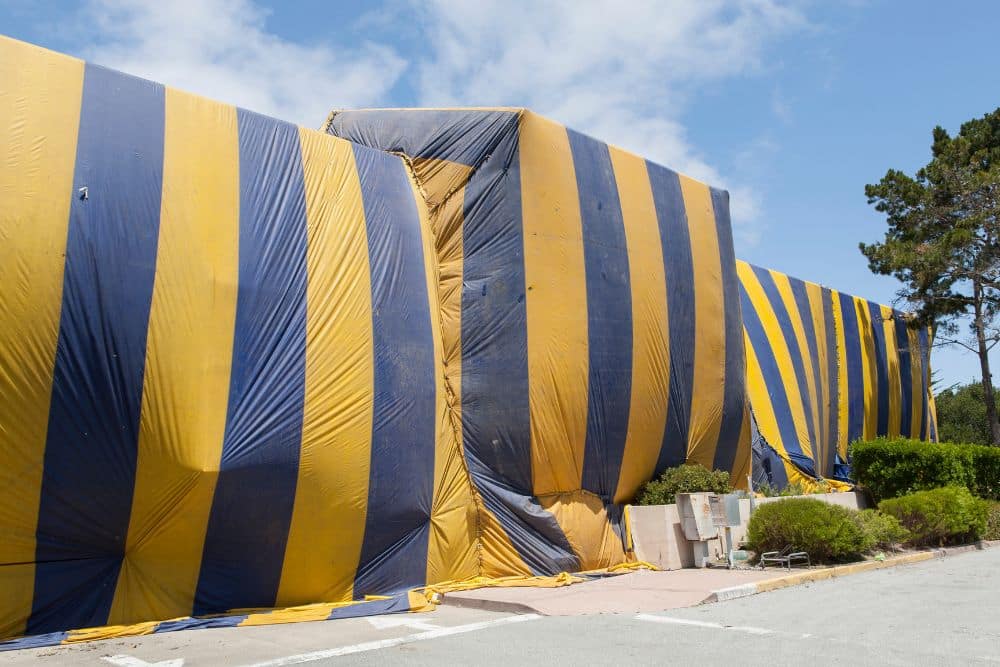
Termite tenting, also called structural fumigation, is a whole-structure treatment commonly used for extensive drywood termite infestations.
During tenting, the structure is covered, and a fumigant is used to penetrate areas where drywood termites may be hidden. The goal is to treat termite activity throughout the enclosed structure, including areas that may not be reachable with a localized treatment.
Tenting may be recommended when:
Drywood termite activity is widespread
Multiple areas of the home show evidence
The infestation is not limited to one accessible location
There are signs in attic framing or inaccessible wall areas
Spot treatment would be unreliable
A whole-structure approach is needed
For drywood termites, the Florida Department of Agriculture and Consumer Services notes that extensive infestations are typically treated by pest management professionals using structural tent fumigation or other appropriate methods, including heat and localized treatments where suitable.
What Tenting Does Well
Tenting is often chosen because it can reach hidden drywood termite colonies inside the structure. That matters when termite activity is not isolated or when the inspection suggests multiple areas may be involved.
Tenting can be effective for:
Widespread drywood termite infestations
Hidden drywood termite activity
Multiple infestation points
Homes where localized treatment may miss colonies
Attics, framing, and enclosed voids affected by drywood termites
For Pasco County homes with older wood framing, attic access concerns, fascia damage, or multiple drywood termite signs, tenting may be the most comprehensive option.
What Tenting Does Not Do
Tenting does not create a long-term protective barrier against future termite entry. It treats the existing target infestation, but it does not prevent termites from returning later.
Tenting is also not a soil treatment. It does not eliminate a subterranean termite colony living outside or below the structure.
That is why a homeowner should never assume that “tenting the house” automatically solves every termite problem. It depends entirely on the termite species and the source of the activity.
What Is Termite Spot Treatment?
Spot treatment is a localized termite treatment used when activity is limited to a specific, accessible area.
For drywood termites, spot treatment may be appropriate when the infestation is isolated to one piece of wood or one clearly defined area. UF/IFAS states that spot treatment may be used for drywood termites when the infestation is localized to a single piece of wood.
Spot treatment may be considered when:
The termite activity is limited
The affected wood is accessible
The colony location is clearly identified
There is no evidence of widespread activity
The home has been carefully inspected
The treatment area can be reached effectively
This option can be attractive because it is usually less disruptive than tenting. But it only makes sense when the inspection supports it.
The Risk With Spot Treatment
The biggest risk with spot treatment is missing hidden termite activity.
Drywood termites can be difficult to map because they live inside the wood they consume. If the visible evidence is only one part of a larger infestation, treating one area may leave other colonies active.
That does not mean spot treatment is bad. It means spot treatment must be used selectively.
For example, a single infested furniture piece or isolated trim board may be a reasonable spot-treatment scenario. Multiple piles of frass in different rooms, repeated swarmers, attic evidence, or unclear activity patterns may point toward a larger issue.
Spot treatment should be based on inspection, not wishful thinking.
What Are Termite Bait Systems?
Termite bait systems are primarily used for subterranean termite control.
Instead of treating drywood termites inside attic framing or furniture, bait systems target termites that forage from the soil. Stations are installed around the property, and termite activity is monitored and managed through bait designed to affect the colony.
Bait systems may be recommended when:
Subterranean termites are active
The home needs ongoing monitoring
Soil treatment is difficult or less desirable
The property has construction conditions that complicate liquid treatment
The homeowner wants a lower-impact exterior strategy
Long-term termite management is a priority
For Pasco County homes, bait systems are especially relevant because subterranean termites can move from soil to structure through cracks, expansion joints, plumbing penetrations, and hidden access points.
What Bait Systems Do Well
Bait systems are designed for ongoing subterranean termite management. They are placed strategically around the home where termites are likely to forage.
They can be especially useful for:
Homes with recurring subterranean termite risk
Properties near moisture, trees, or heavy landscaping
Slab homes with hidden entry points
Homes where trenching or drilling is difficult
Long-term monitoring programs
Reducing colony pressure over time
For homeowners in Hudson, Trinity, Odessa, Land O’ Lakes, Wesley Chapel, and New Port Richey, bait systems can be part of a termite prevention or active control plan depending on inspection findings.
What Bait Systems Do Not Do
Bait systems are not a direct treatment for drywood termites living entirely inside wood above ground.
If drywood termites are active in attic framing, furniture, fascia, or interior trim, exterior bait stations will not solve that problem.
This is where many homeowners get confused. They hear “termite bait” and assume it applies to all termites. It does not. Bait systems are most relevant to subterranean termites.
Termite Tenting vs. Spot Treatment vs. Bait Systems
The practical comparison looks like this.
Tenting is usually associated with widespread drywood termite activity inside the structure.
Spot treatment is best reserved for isolated, accessible drywood termite activity.
Bait systems are used for subterranean termites and long-term exterior colony management.
The wrong match can waste money and leave the home exposed.
If a Pasco County homeowner has drywood termites and chooses only an exterior bait system, the interior drywood colony may continue. If a homeowner has subterranean termites and chooses tenting alone, the soil-based colony can remain active and return to the structure. If a homeowner chooses spot treatment for a widespread drywood problem, hidden colonies may survive.
The treatment has to match the termite.
Local Termite Risk in Pasco County
Pasco County has many termite-friendly conditions: heat, humidity, rain, irrigation, mature trees, older homes, new construction, wood-to-soil contact, and moisture-prone exterior areas.
Hudson and Port Richey homes may deal with older structures, coastal humidity, crawl spaces, sheds, docks, or wood trim. New Port Richey, Holiday, and Tarpon Springs properties may have mature landscaping and older wood components. Wesley Chapel, Trinity, Odessa, and Land O’ Lakes homes may have newer construction, but new does not mean termite-proof.
North Pinellas areas like Palm Harbor and Dunedin can also face termite pressure because of mature neighborhoods, shaded lots, coastal moisture, and older structural details.
Termites do not care whether a home is new, renovated, or expensive. They care about access, wood, moisture, and shelter.
Signs Homeowners Should Not Ignore
Call for a termite inspection if you notice:
Discarded wings
Swarmers near windows or lights
Mud tubes on walls, slabs, or foundations
Wood that sounds hollow
Frass that looks like tiny pellets
Bubbling paint
Soft trim or baseboards
Blistered wood
Sagging floors or damaged fascia
Termite activity in a shed, fence, or deck
Repeated signs after prior treatment
A single sign may not tell you the termite species, but it does tell you that the home needs a closer look.
Why Inspection Comes Before Treatment
A good termite plan starts with evidence.
Before recommending termite tenting, spot treatment, or bait systems, the property should be inspected for:
Type of termite
Location of activity
Extent of infestation
Moisture conditions
Construction type
Access points
Prior treatment history
Damage pattern
Risk of hidden activity
Whether prevention is also needed
This is especially important in Pasco County because homes can have multiple termite pressures. A property may have drywood activity in one area and subterranean risk around the foundation. Treating one does not automatically solve the other.
Questions to Ask Before Choosing a Termite Treatment
Before agreeing to termite service, Pasco County homeowners should ask:
What type of termite is present?
Is the activity drywood or subterranean?
Where was the evidence found?
Is the infestation localized or widespread?
Why is this treatment being recommended?
What does this treatment not cover?
Will I need ongoing monitoring?
Is this treatment corrective, preventive, or both?
What should I change around the property to reduce future risk?
These questions help prevent the most expensive termite mistake: buying the wrong solution for the wrong termite.
How Seabreeze Pest Control Helps Pasco County Homeowners
Seabreeze Pest Control serves Hudson and surrounding communities across Pasco, Hernando, and North Pinellas counties, including Port Richey, New Port Richey, Spring Hill, Holiday, Tarpon Springs, Palm Harbor, Dunedin, and Wesley Chapel.
The goal is not to push one termite method for every home. The goal is to identify the termite, evaluate the structure, explain the treatment options, and recommend the method that fits the problem.
For some homes, that may mean tenting. For others, a localized approach may be appropriate. For subterranean termites, bait systems or other subterranean termite strategies may be part of the plan.
The right termite treatment is the one that matches the biology of the termite and the conditions of the property.
The Bottom Line
Termite tenting vs. spot treatment vs. bait systems is not a simple good-better-best comparison.
Tenting is commonly used for extensive drywood termite infestations. Spot treatment may work for limited, accessible drywood termite activity. Bait systems are designed for subterranean termite management and monitoring.
For Pasco County homeowners, the smartest decision starts with identification. Once the termite species and infestation pattern are clear, the treatment plan becomes much more precise.
Whether the home is in Hudson, Port Richey, New Port Richey, Wesley Chapel, Spring Hill, Tarpon Springs, Palm Harbor, or Dunedin, termites should never be treated casually. The cost of guessing is usually higher than the cost of a proper inspection.

Brian Cummings has led Seabreeze Pest Control for 32 years with a people-first philosophy—care for your team, and they’ll care for your clients. His values shape the trusted, family-owned company Seabreeze is today.